How to Officiate a Wedding Ceremony Step-by-Step: Script, Stagecraft & License Guide
Learning how to officiate a wedding ceremony with warmth, poise, and legal precision is a craft anyone can master when given the right blueprint. Whether you searched how to officiate wedding vows for your best friend or want a seasoned celebrant’s exact altar choreography, this field-tested manual walks you from the Friday rehearsal through all eight spoken parts of the ceremony, the Golden Photo Rule step-aside, and the black-ink marriage license signing table.
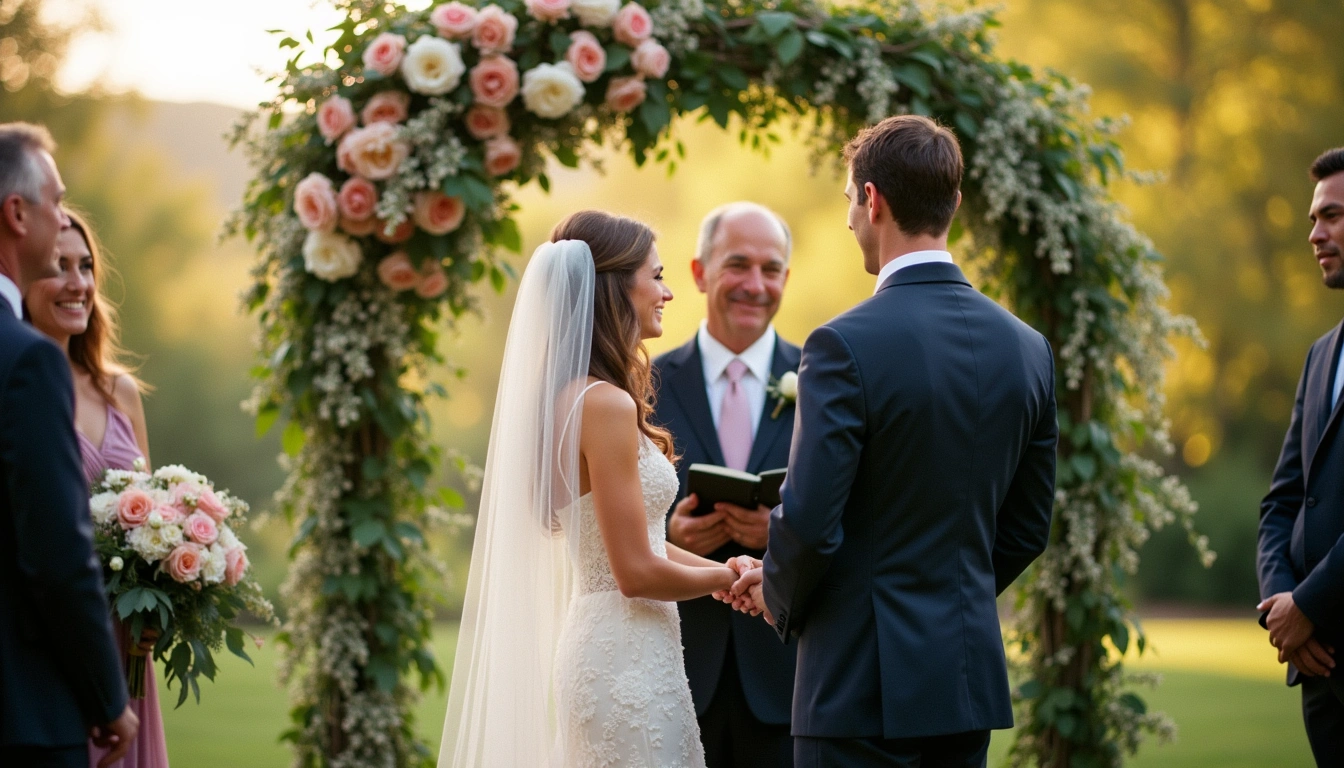
Two prerequisites before writing a single word: legal verification & the couple discovery session
When first-time celebrants research how to officiate wedding ceremonies, it is tempting to jump straight into writing jokes or picking love poems. Resist that impulse for twenty minutes and lock down your two structural pillars first: your statutory authority in the ceremony county and a structured discovery interview with the couple.
If you haven’t completed your free Agape Church ordination ($0) yet, complete that first and verify the venue county in our How to Become a Wedding Officiant 50-State Guide. In 37 direct-recognition states, no state clergy registry exists—whereas 11 pre-registration jurisdictions (including Clark County, NV’s strict 30-day Single-Ceremony cutoff under NRS § 122.062, NYC, Ohio, and Minnesota) require advance filing. Note special civil procedures in Alabama (Act 2019-340 notarized Form ADPH-HS-47 with optional ceremonies), Virginia (Circuit Court authorization under Va. Code §§ 20-23 / 20-25), and Tennessee (statutory restriction on online ordinations under Tenn. Code Ann. § 36-3-301(a)(2)).
Send our free 10-Prompt Couple Interview Worksheet to both partners four weeks before the wedding and ask them to reply separately without peeking at each other’s answers. When two partners independently describe the exact same quiet moment they fell in love—or the exact quirk they admire most—you have pure storytelling gold that makes every guest lean forward. During the same call, align explicitly on religious/spiritual vs. modern civil tone, off-limits topics, pronouncement titles, and ring custody.
The 8-part anatomy of an unforgettable wedding ceremony (with word-for-word scripts & stage directions)
Every memorable wedding ceremony—whether held in a candlelit chapel, a vineyard, or a city rooftop—follows an eight-movement dramatic arc. Notice how Part 05 (Declaration of Intent) and Part 08 (Official Pronouncement) carry mandatory statutory badges: you may customize or streamline everything else, but never omit those two legal pillars.
Processional Arrival, Bouquet Handoff & The Seating Gesture
Objective: Anchor the altar visually with calm posture as the wedding party enters, transition the couple cleanly into their 45-degree marks, and release 120 standing guests so they don’t remain awkwardly on their feet.
Word-for-Word Spoken Script Excerpt“Welcome, family and friends. Please be seated. Before we begin, Elena and Marcus want you to know how much it means to look out and see every person they love most in one place—and they warmly invite you to silence and tuck away your phones and cameras for the next fifteen minutes so you can be fully present with them while their wonderful photographer captures every moment.”
Celebrant Pro-Cue: Forgetting “Please be seated” is the single most common rookie stumble in wedding officiating. Print those three words in bold 18-point capital letters at the very top of Page 1.
Warm Welcome, Gratitude & Family or Memorial Acknowledgments
Objective: Set an unhurried, inclusive emotional tone, briefly state your relationship to the couple in one sentence (never a five-minute autobiography), and honor parents or departed loved ones gracefully.
Word-for-Word Spoken Script Excerpt“Good afternoon, everyone. For those I haven’t had the joy of meeting yet, my name is Daniel, and I’ve had a front-row seat to Marcus and Elena’s friendship and partnership since the autumn they met in Chicago. Today we gather not to create a bond out of thin air, but to witness and celebrate a commitment these two have already built day by day—and as we begin, we also hold close in heart Elena’s late grandfather Arthur, whose kindness and humor live on in this family today.”
Celebrant Pro-Cue: Place memorial tributes near the opening welcome rather than right before the vows. Starting tenderly allows the emotional arc of the ceremony to rise naturally toward joy.
The Couple’s Story & Shared Meaning of Marriage
Objective: Bring the room inside two concrete, vivid scenes that reveal why these two people belong together—avoiding generic dictionary clichés ("Websters defines love as...") and excluding private inside jokes.
Word-for-Word Spoken Script Excerpt“When I asked Elena and Marcus separately when they knew this was forever, neither of them named a grand vacation. Both of them talked about a Tuesday night during a winter power outage—sitting on the living room floor surrounded by tea lights, laughing over cold takeout, and realizing that even when plans fall apart, home is wherever the other person is sitting. That is the quiet superpower of a great marriage: choosing curiosity over ego, humor over frustration, and steadiness through every season ahead.”
Celebrant Pro-Cue: Follow the 80/20 Rule of Ceremony Humor: 80% heartfelt warmth, 20% gentle affectionate wit—and zero references to ex-partners, bachelor parties, or cold feet.
Optional Guest Reading, Scripture, Poetry or Cultural Blessing
Objective: Invite a sibling, grandparent, or mentor into the liturgy to share a sacred scripture passage, poem, or literary reflection chosen by the couple.
Word-for-Word Spoken Script Excerpt“To offer a reflection on enduring partnership, I’d now like to invite Marcus’s sister, Hannah Lin, forward to share a reading from 1 Corinthians 13 / Mary Oliver’s ‘Wild Geese.’”
Celebrant Pro-Cue: Always print a backup copy of the guest reading inside the back tab of your ceremony binder—at least once every few weddings, a nervous guest reader leaves their folded paper back at their chair.
Mandatory Legal Element #1: The Declaration of Intent (“I Do”)
Objective: Establish clear, audible, present-tense, uncoerced mutual consent to enter into marriage in the physical presence of the authorized officiant and attending witnesses—required across state marriage statutes.
Word-for-Word Spoken Script Excerpt“Marcus, do you freely take Elena to be your lawful wedded wife / spouse—promising to stand beside her in joy and in challenge, to honor her dignity, and to love her faithfully all the days of your life?” [Partner answers: “I do.”] “And Elena, do you freely take Marcus to be your lawful wedded husband / spouse—promising to stand beside him in joy and in challenge, to honor his dignity, and to love him faithfully all the days of your life?” [Partner answers: “I do.”]
Celebrant Pro-Cue: Never replace the Declaration of Intent with vague humor ("Sure, why not?"). County domestic-relations statutes require an unmistakable affirmative declaration that both parties take each other as spouses.
Spoken Marriage Vows (Personal Written Vows vs. Repeat-After-Me)
Objective: Facilitate the emotional pinnacle of the ceremony—either guiding each partner cleanly through their personal written vows or feeding calm, bite-sized phrases for traditional repeat-after-me vows.
Word-for-Word Spoken Script ExcerptRepeat-After-Me Cadence: “Please repeat after me: I, Elena, choose you, Marcus... / to be my partner and my best friend... / from this day forward... / for better, for worse... / in plenty and in want... / in sickness and in health... / to love, cherish, and grow alongside you... / for all the days of our lives.”
Celebrant Pro-Cue: Collect both partners’ personal vows via email 5 days before the wedding and print them onto heavy cream cards. Neither partner will ever have to squint at a cracked smartphone screen at the altar.
The Exchange of Wedding Rings (& Optional Unity Ritual)
Objective: Coordinate a calm ring handoff from the Best Man or Ring Bearer and guide each partner as they place the band onto the fourth finger of their spouse’s left hand.
Word-for-Word Spoken Script Excerpt“These rings are unbroken circles—symbols of a promise with no beginning and no end. Marcus, as you place this ring on Elena’s hand, please repeat after me: Elena, I give you this ring... / as a daily sign of my love... / my loyalty, and my promise to you. [Switch:] Elena, as you place this ring on Marcus’s hand, please repeat after me: Marcus, I give you this ring... / as a daily sign of my love... / my loyalty, and my promise to you.”
Celebrant Pro-Cue: Summer heat swells fingers. Remind couples at the rehearsal that if a ring pauses at the knuckle, they should simply smile and let their partner slide it the final half-inch effortlessly.
Mandatory Legal Element #2: Official Pronouncement, Step-Aside & Presentation
Objective: Solemnly pronounce the marriage under the laws of the ceremony state, clear the center-aisle sightline completely before the First Kiss, and launch the joyous recessional.
Word-for-Word Spoken Script Excerpt“Elena and Marcus, having declared your mutual consent and exchanged your vows and rings before God and these witnesses—by the authority vested in me as an ordained minister and under the laws of the State of [Ceremony State], I now pronounce you husband and wife / married partners for life! You may share your first kiss!” [STEP TWO FULL PACES ASIDE IMMEDIATELY. After kiss & applause:] “Family and friends, it is my greatest honor to present to you, for the very first time, Elena and Marcus [Chosen Last Name(s)]!”
Celebrant Pro-Cue: Confirm in writing during your couple interview exact pronouncement wording ("husband and wife," "partners in marriage," "wife and wife," "husband and husband") and exact post-wedding names for the final presentation.
Watch: How to structure and pace a modern wedding ceremony script
Hear how these ceremony movements sound out loud when connected together with natural transitions and conversational warmth:
An 8-minute spoken structural walkthrough showing how opening hospitality, personal storytelling, the legal Declaration of Intent, vows, ring exchange, and pronouncement lock together without awkward dead air.
- Open immediately with warmth and guest comfort (“Please be seated”) so the entire room relaxes in the first 15 seconds.
- Transition smoothly between storytelling and the vows by asking the couple to turn, face each other fully, and take each other’s hands.
- Keep repeat-after-me phrases short (5–7 words per chunk) so emotional spouses never struggle to remember long clauses.
- Build energetic momentum into your final pronouncement and newlywed presentation so applause erupts naturally.
Altar positioning blueprint & “The Golden Photo Rule” before the First Kiss
Ask any full-time wedding photographer for their single biggest pet peeve, and you will hear the exact same answer within two seconds: the first-time friend officiant who stands frozen directly behind the couple’s noses during the First Kiss—smiling awkwardly between their faces in the most important photograph of the day. Study this overhead architectural blocking diagram once, rehearse it Friday afternoon, and your photographer will thank you profusely:
Calculate your exact ceremony word count, duration & stagecraft cues
In everyday dinner conversation, adults speak at roughly 145 to 160 words per minute. Over an outdoor PA speaker or vaulted sanctuary acoustics, 150 WPM blurs consonants together and makes heartfelt vows feel rushed. Seasoned celebrants pace ceremonies at 110 words per minute—about 25% slower than casual speech—leaving breathing room for laughter, acoustic echo, and emotion. Customize your couple’s run-of-show below and copy it straight into your rehearsal notes:
Build your minute-by-minute ceremony timeline & stagecraft cues
Stand centered at altar. After couple arrives and hands off bouquet, smile warmly and say: “Please be seated.” Deliver 20-second unplugged ceremony invitation before opening remarks.
Hold dark non-glare binder at waist/chest level; keep microphone 3–4 inches from chin. Share 2 specific stories about Alex and Jordan.
Step half a pace back and hand handheld mic cleanly to the reader (or angle stand mic).
MANDATORY LEGAL ELEMENT #1: Invite Alex and Jordan to face each other and join hands. Ask each partner cleanly for free mutual consent.
Offer printed vow cards from your binder pocket so neither partner reads off a glowing smartphone. Angle mic gently toward the speaking partner.
Cue Best Man / Ring Bearer softly. Have each partner repeat ring vows while placing band on the left fourth finger.
MANDATORY LEGAL ELEMENT #2 + GOLDEN PHOTO RULE: Pronounce Alex and Jordan married, invite the kiss—and IMMEDIATELY take two full steps laterally out of the center frame BEFORE lips meet!
How to run a calm, decisive 20-minute wedding rehearsal
If the couple hired a full-time wedding planner, ask the planner five minutes before start time: “Would you like to cue the processional spacing while I run the altar blocking from the front?” Collaborating smoothly makes you look like a consummate pro. If there is no day-of coordinator—which happens at thousands of backyard, restaurant, national-park, and boutique weddings—everyone will look to you to lead the rehearsal. Never let a rehearsal drag past 25 minutes while twenty hungry relatives wait for dinner:
Start at the Altar & Work Backward (Never Start in the Lobby)
Gather the couple, attendants, parents, and readers right at the ceremony arch first. Show everyone their exact standing spot, 45-degree foot placement, and balanced spacing so the entire party knows where they are walking toward.
Choreograph Hands-Free Mechanics: Bouquet, Rings & Vow Cards
Rehearse the exact second the bouquet passes to the Maid of Honor, verify who carries the actual metal wedding bands on ceremony day (rarely a four-year-old toddler on a pillow over wooden deck slats!), and test microphone heights.
Practice the First-Kiss Step-Aside & Recessional Exit Order
Show the photographer your exact lateral step-aside direction (left or right depending on sun angle and aisle camera), practice the newlywed turn-and-present applause cue, and walk the recessional pairing order halfway down the aisle.
Run One Complete Processional to Music & Appoint the License Custodian
Walk everyone to the starting staging area and run one smooth processional at calm walking pace (five full pews of spacing between pairs). Before dismissing to rehearsal dinner, confirm by name who hands you the physical marriage license tomorrow.
Microphone, binder & wardrobe stagecraft: the small details that separate pros from amateurs
Even the most poetic wedding script falls flat if Row 6 cannot hear the vows over a garden fountain or if a glowing tablet washes out your face in every photograph. Master these four physical craft pillars before wedding morning:
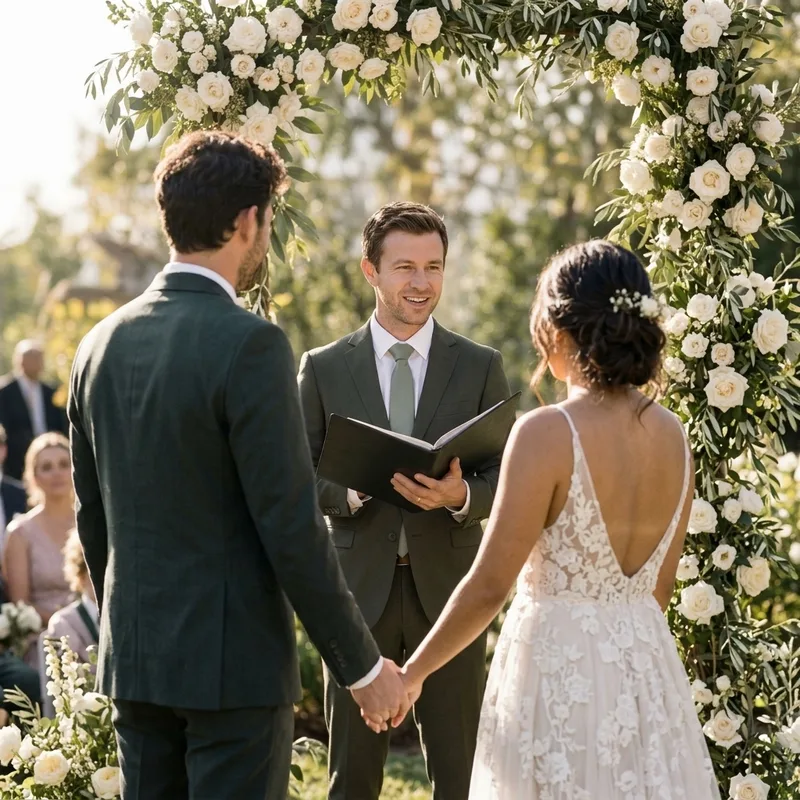
1. The Dark Matte Binder & 14pt–16pt Cream Typography Standard
Leave tablets, Kindles, and smartphones inside your coat bag. Glowing screens cast eerie blue upward light onto your face at dusk, trigger thermal shutdown warnings in direct summer sun, and risk lock-screen blackouts mid-vow. Instead, print single-sided on 28–32 lb matte cream or ivory paper (pure bright-white copy paper acts like a blinding reflector board under midday sun!) using 14pt to 16pt serif type with 1.5x line spacing and generous margins. Never split a sentence across a page turn, and house your pages inside a slim dark navy, deep forest, or black leatherette folio.
2. Microphone Technique (Handheld Cardioid vs. Lapel Lavalier)
Arrive 30 minutes early to run a live voice check with the DJ or A/V engineer. If using a wireless handheld cardioid mic (the gold standard for windy outdoor venues), hold the grille 3 to 4 inches from your chin—holding a mic down by your tie drops volume by 80%. During the Declaration of Intent and spoken vows, angle the capsule smoothly 4 inches below the speaking partner’s chin without thrusting it into their face. If wearing a clip-on lapel lavalier, remember your mic is hot from the moment you clip it on: never whisper private logistics near the arch, and ask the DJ to fade your channel down right as you step aside for the First Kiss.
3. Camera-Friendly Wardrobe Harmony
Think of yourself as the picture frame and the couple as the oil painting. Choose grounded, matte tailoring—charcoal gray, classic navy, deep olive-forest, or black—paired with muted neckwear or understated formal attire. Avoid bright white, neon florals, tight micro-checkered patterns that shimmer on 4K video sensors, noisy wrist bangles on your mic hand, and mirrored sunglasses outdoors (squinting beats wearing reflective aviators during vows!).
Live altar troubleshooting: handling wind, tears, dropped rings & noise with calm grace
Pause calmly, offer a warm grounding smile, and never fill the silence with nervous chatter. Keep a clean folded white cotton handkerchief inside your binder pocket to pass discreetly with your free hand.
Use matte, non-glare heavyweight cardstock pages secured in a 3-ring folio with flat brass book clips at the bottom corners—loose sheets of 20-lb printer paper turn into kites outdoors.
Stay completely composed. If it drops, step half a pace back so the couple or Best Man retrieves it gracefully, smile warmly, and say softly, “Gravity approves—right where we left off.” Never turn a tiny hiccup into slapstick.
Stop speaking at the end of a phrase, hold warm eye contact with the couple for five seconds until the peak noise passes, and repeat the key sentence cleanly—especially during the Declaration of Intent.
Watch: How to read your ceremony script naturally without sounding like a robot
You never need to memorize a 15-minute wedding ceremony—in fact, trying to memorize vows from scratch invites adrenaline blank-outs! Watch how professional officiants format their printed script pages so they maintain 80% warm eye contact while reading effortlessly:

A 13-minute masterclass on typography layout, breath-group line breaks, the ‘glance-grab-deliver’ eye-contact technique, and calming wedding-day nerves at the microphone.
- Break paragraphs into short visual breath phrases (one thought per line) so your eye snaps back to your exact spot instantly.
- Use the “Glance, Grab, Deliver” rhythm: look down silently to absorb 6–8 words, lift your eyes to the couple or guests, and speak while making genuine eye contact.
- Read your entire ceremony out loud standing up at least three times before rehearsal day to catch tongue-twisters and time your 110-WPM cadence.
- Embed bold bracketed cues ([PAUSE — SMILE], [INVITE GUESTS TO SIT], [STEP ASIDE BEFORE KISS]) directly inside your printed script.
The 5-minute post-recessional signing table & marriage license chain of custody
The applause erupts, the recessional song swells, and the newlyweds beam all the way back down the aisle. Your public performance is complete—but your most important statutory duty happens in the next five minutes. Follow this exact signing-table sequence before anyone wanders off toward champagne and appetizers:
- Step 1: Convene Immediately at a Quiet, Flat Signing Table Ask the Maid of Honor, Best Man (or the couple’s two chosen adult witnesses, age 18+) to walk straight with you and the couple into the bridal suite or a quiet side table for four minutes right after the recessional. Trying to track down witnesses two hours into an open-bar reception is a recipe for smeared ink and missing middle names.
- Step 2: Use Only Permanent Black Ballpoint Ink (Zero White-Out, Zero Gel Smudges) County vital-records optical scanners mandate permanent black ink (some counties explicitly reject blue ink or felt-tip markers). Hand out your own tested black ballpoint pen. If anyone makes a typo, never use correction fluid or scratch over letters—pause and call the issuing clerk on the next business day for correction instructions.
-
Step 3: Complete the Officiant & Witness Blocks Field-by-Field
Inspect every line carefully (and rehearse ahead of time using our Interactive Marriage License Signing Simulator). Enter the exact ceremony date, ceremony city/municipality and county, your signature matching your government ID, your printed name and address, your title (typically
Ordained Minister), and your religious body (Agape Church International). In pre-registration states like Minnesota or Arkansas, include the exact county where your credentials were recorded. Verify the required number of witness signatures (for example, 2 witnesses in CA, MN, WI, NC, and UT; at least 1 in NY and NV; 0 witness lines on standard returns in TX, FL, OH, MA, VA, CO, and D.C.). - Step 4: Separate the Couple’s Keepsake Copy From the Official Clerk Return Many county marriage packets include a decorative ceremonial souvenir certificate alongside the official vital-records return form. Hand the souvenir keepsake copy to the couple’s designated family member, and place the official signed marriage license directly into a rigid protective folder in your own briefcase—never leave the official civil return loose on a reception table!
- Step 5: Return to the Issuing Clerk With Tracking Ahead of Statutory Deadlines Under state domestic-relations statutes, the officiant—not the honeymooning couple—is legally responsible for returning the executed marriage license on time. Deadlines arrive fast: 3 days in Tennessee, 5 days in New York, Minnesota, and Virginia, 10 days in California, Nevada, Pennsylvania, Washington D.C., and Wyoming, and 30 days in Texas, Ohio, and Utah. Drop the license off at the issuing clerk’s counter in person on Monday morning or mail it inside a flat rigid mailer via USPS Priority Mail or Certified Mail with tracking, and text the tracking number to the couple as a wedding-week peace-of-mind gift.
Frequently asked questions on how to officiate a wedding ceremony
How long should a wedding ceremony be when a friend or ordained minister officiates?
For modern non-liturgical and interfaith weddings, the gold-standard ceremony duration is 12 to 18 minutes from the end of the processional to the recessional kiss (roughly 1,300 to 1,950 spoken words delivered at a calm 110 words per minute). Short elopements typically run 7 to 10 minutes, while traditional scripture-and-unity ceremonies run 18 to 25 minutes. Ceremonies under 6 minutes can feel abruptly rushed after guests traveled hours to attend, whereas non-mass scripts exceeding 28 minutes risk losing guest focus—especially outdoors.
What exact words are legally required when you officiate a wedding ceremony?
Most U.S. state marriage statutes state that “no particular form is required” for the ceremony liturgy, EXCEPT for two universal legal pillars: (1) the Declaration of Intent, in which both parties solemnly and audibly declare in the physical presence of the authorized officiant and witnesses that they freely take each other as spouses (“I do”), and (2) the Official Pronouncement, in which the authorized officiant pronounces them married under the laws of the ceremony state. Always check your specific ceremony state in our 50-State Marriage Laws Directory for any local phrasing notes.
Why shouldn’t I read my wedding ceremony script off an iPad or iPhone?
Three practical reasons every wedding photographer and coordinator begs officiants to ditch glowing screens: first, tablet and phone screens project harsh blue-white LED light upward onto your chin and glasses in ceremony photographs; second, direct afternoon sunlight causes iPads to dim or trigger high-temperature shutdown warnings mid-ceremony; and third, accidental screen rotation, auto-lock timeouts, or incoming banners break your concentration. Always print your script in 14pt–16pt serif type on matte cream paper inside a dark leatherette binder.
Do we sign the marriage license during the ceremony or after the recessional?
In over 95% of American weddings, you sign the official civil marriage license immediately AFTER the recessional—within five minutes of walking back down the aisle, at a quiet flat table with the couple and the required adult witnesses before anyone heads into cocktail hour. Signing mid-ceremony slows momentum and often forces people to write on uneven altar pedestals, increasing the risk of smudged ink or misplaced signatures.
What should a wedding officiant wear to the ceremony?
Dress one notch more tailored and understated than the average guest while harmonizing visually with the wedding party. Classic dark charcoal, navy, deep forest olive, or black suiting or structured formalwear works cleanly in every camera exposure—avoid bright white (reserved for brides), neon prints, bold busy plaids that moiré on video cameras, oversized pocket squares, or clinking metal bracelets on your microphone-holding wrist. If you are an active pastor asked to wear clerical attire or a stole, confirm that preference directly with the couple.
What do I write for Title and Denomination when signing the marriage license?
Read the exact labels printed on the couple’s county marriage license first, and practice inside our Interactive Marriage License Signing Simulator at /license-guide. On standard clergy solemnization blocks, ministers ordained through Agape Church International typically enter “Ordained Minister” under Official Title and “Agape Church International” under Religious Body / Denomination, using permanent black ballpoint ink. In pre-registration states like Minnesota or Arkansas, also endorse the exact county and book/page where your ministerial credentials were recorded.
What happens if someone makes a mistake or smudge while signing the marriage license?
STOP immediately—never apply liquid white-out, correction tape, or heavy scribble cross-outs to an official vital-records marriage license. County vital-records offices reject altered documents under fraud-prevention rules. Instead, set the pen down and call the issuing County or City Clerk’s marriage desk on the next business morning; depending on the county, the clerk will either supply a simple Officiant Affidavit of Correction form or issue a clean duplicate license copy before filing.
Do I need to get ordained and register locally before learning how to officiate a wedding?
Yes—inspiring stagecraft only counts legally if your underlying statutory authority is rock-solid in the county where the ceremony physically happens. In 37 direct-recognition states, free $0 ordination with Agape Church International equips you without statewide pre-registration. In 11 pre-registration jurisdictions (including Clark County NV with its 30-day Single-Ceremony cutoff, New York City, Ohio, Minnesota, Hawaii, Massachusetts, and Washington D.C.), you must file with government authorities ahead of wedding day. Remember also that Alabama uses notarized Form ADPH-HS-47 (making ceremonies optional), Virginia requires a Circuit Court Order, and Tennessee restricts online ordinations by statute under Tenn. Code Ann. § 36-3-301(a)(2).
Pair ceremony stagecraft with verified legal & script tools
50-state statutory breakdown, interactive eligibility calculator & county pre-registration deadlines.
Mix and match openings, readings, vows, unity rituals, and pronouncements in minutes.
Visual line-by-line walkthrough of officiant title, denomination, witnesses & return rules.
Tailored roadmap for friends, siblings, and parents asked to officiate a loved one’s wedding.
Permanent ministerial credentials for weddings, baptisms, funerals, chaplaincy & fellowship.
Ecclesiastical title standards, public registry lookup at /verify, and clerk verification desk (/clerks).
Comparing ordination ministries or preparing your couple discovery call? Check our 10-Prompt Couple Questionnaire, our Online Ordination Ministry Comparison, the Agape Public Clergy Registry, and our County Clerk Verification Desk.
Embed Card Wedding Planners, Venues & Journalists: Embed This Reference Summary on Your Site ▼
Copy and paste the self-contained HTML card below into any WordPress, Squarespace, Showit, or venue planning guide to share this verified statutory summary with couples and friend officiants:
Step up to the altar with complete legal & spoken confidence
Complete your free ecclesiastical ordination with Agape Church International in two minutes, check your ceremony county’s exact rules in our 50-State Marriage Laws Directory, and customize your spoken script today.