How to Become a Wedding Officiant Online ($0): The Complete 50-State Playbook
Being asked by a best friend, sibling, or family member to preside over their wedding is one of the highest personal honors you will ever receive. Whether you searched how to become a wedding officiant, how do you become a marriage officiant, or how to qualify as an ordained wedding officiant without paying surprise kit markups, this primary-source guide maps every legal requirement across all 50 states, Washington, D.C., and 3,143 county clerk jurisdictions.

How can I become a wedding officiant? Understanding civil vs. ordained authority
When friends ask “how can I become a wedding officiant?” or “how do you become a wedding officiant for a family wedding?” they are often surprised to learn that the United States has no federal marriage bureau and no national “wedding officiant license.” Instead, marriage solemnization is governed entirely by state domestic-relations statutes—and administered locally by County Clerks, City Clerks, Probate Courts, or Parish Clerks of Court.
Across state marriage codes, the law authorizes two primary categories of people to solemnize a civil marriage contract:
Every state’s marriage statute recognizes ministers, pastors, priests, rabbis, and spiritual leaders ordained according to the customs of a religious denomination or church society. Becoming an ordained marriage officiant (often searched as how to become a marriage minister or wedding officiant ordination) through Agape Church International ($0) grants lifelong ministerial credentials—which you then pair with any required local county registration.
Judges, magistrates, justices of the peace, and elected county clerks hold civil authority by virtue of public office (and in Florida, Maine, South Carolina, Montana, Nevada, and Tennessee, commissioned state Notaries Public). Only a handful of jurisdictions—such as California counties, Massachusetts, New York City, Washington, D.C., and Virginia (for residents)—offer a one-day secular deputy marriage appointment to private citizens.
That statutory design explains why wedding officiant ordination is the standard route for first-time friend and family officiants across the country. If you are wondering how to become a marriage officiant or how to become officiant for wedding ceremonies in states like Texas, Florida, Illinois, Arizona, Georgia, Michigan, North Carolina, or Washington, none of those states operate a secular “Deputy for a Day” counter for private friends—meaning becoming an ordained officiant is the cleanest, zero-cost legal route when you can affirm your ordaining church’s creed sincerely.
Before doing anything else, memorize the Iron Rule of Venue Jurisdiction: only the law of the exact county and state where the couple physically exchanges vows governs your ceremony. Where you live does not control. Where the couple lives does not control. Even where the reception dinner is hosted later that night does not control if the vows take place across a river or state border. Always look up the ceremony venue’s county in our 50-State Marriage Laws Directory first.
The 3-Pillar Marriage Authority Architecture: Never confuse church ordination with county paperwork
Roughly 95% of first-time officiant stress disappears the moment you separate three distinct legal tracks. Church ordination establishes who you are spiritually; local clerk registration (where required) records your authority in a specific civil jurisdiction; and the couple’s marriage license authorizes this specific marriage contract.
Why Pillar 1 Is Always $0 at Agape
Ecclesiastical ordination is a sacred ministerial act—never a paywall. Agape Church International operates under IRC § 508(c)(1)(A) and records every ordained minister in our public Agape Clergy Registry with zero application or annual renewal fees.
When Pillar 2 Applies (And Doesn’t)
In 37 states—including Texas, California, Florida, Illinois, Colorado, and Washington—no state clergy registry exists. Only 11 pre-registration jurisdictions (plus Virginia’s Circuit Court system) require a separate government filing ahead of wedding day.
Why Pillar 3 Belongs to Both of You
You never apply for the marriage license on the couple’s behalf—the couple obtains it directly from the County or City Clerk. Your statutory duty begins on wedding day: inspecting the license, hearing mutual consent, signing in black ink, and returning it on time.
Check your ceremony state’s exact lead-time deadline, witness rule & paperwork
Select the state where the wedding ceremony will physically take place, enter your optional ceremony date to test county lead-time cutoffs, and view primary-source statutory requirements instantly:
Check your exact ceremony-state deadline, paperwork & cost
Under Texas Family Code § 2.202(a)(1)–(3), an ordained Christian minister or priest, a Jewish rabbi, or a person who is an officer of a religious organization and authorized by that organization to conduct a marriage ceremony is authorized to solemnize marriages across all 254 Texas counties without pre-registering with the state or County Clerk. CRITICAL TIMING RULES: Under Tex. Fam. Code § 2.204, the ceremony may NOT take place during the 72-hour waiting period immediately following license issuance (unless waived for active-duty military, Twogether in Texas premarital course completion, or judicial waiver); the license expires 90 days after issuance (§ 2.201); and the officiant must mail or return the signed license to the issuing County Clerk within 30 days after the ceremony (§ 2.206). Verify current county license fees directly with the County Clerk.
The 6-phase playbook: from wedding officiant ordination to filing the signed license
Whether the wedding is three months away or coming up next month, follow these six chronological phases in exact order so nothing slips through the cracks.
Verify the Exact Ceremony-County Jurisdiction & Cutoff Window
Marriage solemnization is governed strictly by the state and county where the couple physically stands during the ceremony—never where you live or where the couple resides.
- Confirm the physical venue address first. A wedding five miles across a state line (for example, Kansas City MO vs. Overland Park KS, or Jersey City NJ vs. Manhattan NY) changes the entire statutory rulebook.
- Check minimum officiant age rules: nearly every state sets the minimum age at 18, whereas Minnesota statute (Minn. Stat. § 517.04) requires ministers to be at least 21 years old.
- Identify hard pre-filing deadlines immediately: Clark County (Las Vegas), Nevada requires Single-Ceremony applications and online county training to arrive at least 30 days prior to the wedding under NRS § 122.062.
Complete Your Free Wedding Officiant Ordination ($0) with Legal-ID Accuracy
Apply through Agape Church International’s four-step ordination application at $0 cost ($0 application fee and $0 lifetime renewal fees) using your exact government-ID legal name.
- Enter your full legal name exactly as printed on your driver’s license or passport. Avoid nicknames ("Mike" instead of "Michael") so county clerks can match your ID to your ordination record without friction.
- Affirm the Agape Creed in good conscience. Upon submission, your permanent Credential ID is recorded in the public Agape Clergy Registry for instant county clerk lookup.
- Download and save your 3-page printable digital credential packet (Certificate of Ordination, Letter of Good Standing, and Clergy Wallet Card) to both cloud storage and hard copy.
File Local Government Officiant Registration (Only in Pre-Registration States)
If your ceremony is in one of the 37 direct-recognition states, skip statewide pre-filing. If your ceremony is in one of the 11 pre-registration jurisdictions (or Virginia), submit your government filing now.
- Statewide portal filings: Ohio (Secretary of State Minister’s License), West Virginia (Secretary of State Marriage Celebrant Registry), Massachusetts (Secretary of the Commonwealth Commissions Section), and Hawaii (Department of Health eMRS Performer Portal).
- County or municipal clerk filings: New York City (NYC Office of the City Clerk for all five boroughs), Nevada counties, Minnesota County Recorders, Arkansas County Clerks, Oklahoma County Court Clerks, Louisiana Parish Clerks of Court, and the D.C. Superior Court Marriage Bureau.
- When a clerk requires physical gold-foil embossed certificates or wet-ink notarized Letters of Good Standing, order physical documents at least 3–4 weeks ahead of your clerk submission.
Interview the Couple & Draft Your Spoken Ceremony Script
Conduct a relaxed 45-minute discovery conversation with the couple to lock in spiritual vs. modern tone, personal anecdotes, vow format, and the two mandatory spoken legal elements.
- Use a structured 10-question couple interview worksheet so each partner answers independently before you weave their story together.
- Build your ceremony around the two universal legal pillars of marriage solemnization: (1) the mutual Declaration of Intent ("I do") and (2) your Official Pronouncement of marriage.
- Target 1,300 to 1,700 total spoken words—delivered at a calm, resonant 110 words per minute, that yields an ideal 12-to-15-minute ceremony that keeps every guest engaged.
Audit the Marriage License Before the Processional & Lead with Calm Stagecraft
Inspect the couple’s physical marriage license 30 minutes before guests take their seats, print your script in a non-glare binder, and lead the ceremony with poised authority.
- Check three license fields before walking out: (a) has the mandatory waiting period elapsed to the exact minute (for example, NY’s 24-hour rule or TX/FL’s 72-hour rule)? (b) is today inside the expiration window? (c) is the license valid in this county/state?
- Print your script in 14pt–16pt serif type inside a dark matte binder—never read vows from a glowing iPad or smartphone at the altar.
- Follow the Golden Photo Rule: immediately after pronouncing the couple married and inviting their first kiss, step two full paces laterally out of the center frame before their lips meet.
Execute Permanent Black-Ink Signatures & Track License Return
Gather the couple and adult witnesses at a quiet signing table right after the recessional, complete the officiant block cleanly in black ballpoint ink, and return the license before the statutory deadline.
- Sign solely in permanent black ballpoint ink (never blue ink, gel pens that smear, or erasable pens). Never use correction fluid or cross out mistakes.
- Enter accurate ecclesiastical details where requested—typically "Ordained Minister" under Official Title and "Agape Church International" under Religious Denomination or Body.
- Deliver the completed license to the issuing County or City Clerk in person or via USPS Priority/Certified Mail with tracking well ahead of statutory deadlines (as short as 3 days in TN or 5 days in NY, MN, and VA).
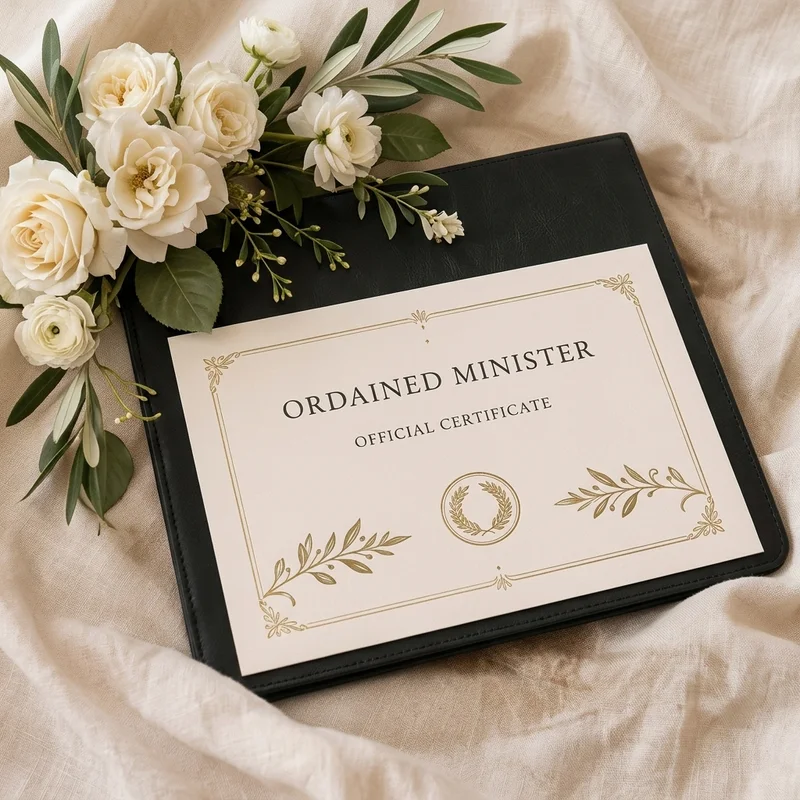
What county clerks actually verify on an ordination certificate & Letter of Good Standing
When you file credentials in a pre-registration jurisdiction—or keep a backup copy inside your ceremony binder—government clerks check four concrete data points:
- Exact Legal Name Match: Your full legal name must match your government photo ID without abbreviations.
- Ordination Effective Date Prior to Wedding Day: Your ordination date must precede both any local clerk registration and the marriage solemnization date.
- Active Good Standing Attestation: Jurisdictions like New York City, Clark County, NV, and Washington, D.C. specifically inspect a current Letter of Good Standing confirming your ministerial status is active and unrevoked.
- Verifiable Church Registry Reference: Every Agape credential carries a unique Credential ID verifiable 24/7 by clerks at ordainedministers.org/verify and through our County Clerk Verification Desk.
Watch: Your 10-step game plan for becoming a first-time wedding officiant
Prefer watching a real-world walkthrough before you dive into script writing? Veteran celebrant educator Mark Allan Groleau breaks down the complete arc from legal ordination and local marriage laws to interviewing the couple and commanding the ceremony space:

A comprehensive 25-minute orientation for friend and family officiants covering legal eligibility, timeline milestones, couple storytelling, rehearsal confidence, and marriage license execution.
- Treat legal qualification (ordination + checking local county clerk registration) as Day-1 infrastructure so you can spend the final month focused 100% on the couple’s story.
- Ask both partners open-ended storytelling prompts separately before drafting a single paragraph of spoken remarks.
- Keep your ceremony centered on the couple rather than long abstract lectures—12 to 15 minutes at a relaxed 110 WPM cadence is the sweet spot for modern weddings.
- Confirm who brings the physical marriage license to the rehearsal or ceremony venue and inspect waiting-period dates before guests arrive.
Every U.S. state & D.C. classified by officiant registration law
To spare you from digging through fifty separate legislative codebooks, our registrar team audits every state’s domestic-relations statute directly against official legislature portals and county clerk handbooks. Every U.S. jurisdiction falls into one of three statutory tiers:
No statewide government officiant pre-registration required
In these 37 states, state government does not maintain a statewide minister registration office. Once you complete your free Agape Church ordination, you confirm any local county instructions on the couple’s marriage license packet, keep a printed copy of your ordination certificate in your binder, solemnize the ceremony, and complete the officiant signature block in black ink. Click any state below for its statute citation, waiting period, witness count, and return deadline:
Where ordained ministers must register with a government office before the wedding
In the 11 jurisdictions below, church ordination is Step 1, and filing your ministerial credentials with a Secretary of State, Department of Health, County Clerk, or City Clerk prior to performing the ceremony is Step 2. Never perform a wedding in these jurisdictions until your government approval or credential recording is complete:
| Jurisdiction & Statute | Government Filing Office | Rec. Lead Window | Key Statutory Rule |
|---|---|---|---|
| Arkansas Ark. Code Ann. §§ 9-11-213 & 9-11-214 | Any Arkansas County Clerk (valid statewide once recorded) | 14–21+ days | Record ordination credentials in one of Arkansas’s 75 counties prior to the ceremony and endorse the exact book/page and county of recording on every marriage license you sign. |
| District of Columbia D.C. Code § 46-406 | D.C. Superior Court Marriage Bureau | 21–30+ days | Every celebrant must receive D.C. Marriage Bureau approval (Religious Celebrant or Temporary One-Time Officiant) before the wedding; D.C. also permits self-officiating elections. |
| Hawaii Haw. Rev. Stat. §§ 572-12 & 572-13 | Hawaii Dept. of Health Performer Registry (eMRS) | 21–30+ days | Mandatory online Marriage Performer registration and approval through Hawaii DOH’s Electronic Marriage and Civil Union Registration System (eMRS) prior to ceremony day. |
| Louisiana La. R.S. 9:202–9:204 | Parish Clerk of Court (or Orleans Parish Vital Records) | 14–28+ days | Deposit a notarized Marriage Officiant Affidavit along with ordination credentials in the parish where the ceremony occurs; note Louisiana’s 24-hour license waiting period. |
| Massachusetts Mass. Gen. Laws ch. 207, §§ 38–39 | MA Secretary of the Commonwealth — Commissions Section | 28–42+ days | Out-of-state ministers must obtain a Non-Resident Clergy Certificate ahead of the specific wedding (resident clergy file under § 38; Governor’s 1-Day Designation also available). |
| Minnesota Minn. Stat. §§ 517.04–517.05 | Any Minnesota County Recorder / Local Registrar | 14–21+ days | Officiant must be age 21+, file ordination credentials + Certificate of Filing with any MN county before the wedding, and endorse that filing county on the marriage certificate. |
| Nevada (incl. Clark County / Las Vegas) NRS §§ 122.062–122.066 | Nevada County Clerk — Marriage Services Division | 30–45+ days (Hard 30-day cutoff in Clark County) | County Certificate of Permission mandatory before officiating. Clark County Single-Ceremony filings require county online training + notarized forms received 30+ days out. |
| New York (NYC Five Boroughs) N.Y. Dom. Rel. Law §§ 11, 11-B & 11-D | NYC Office of the City Clerk (inside Manhattan, Brooklyn, Queens, Bronx, Staten Island) | 21–35+ days | Pre-registration (or NYC 1-Day Officiant License) mandatory inside NYC’s 5 boroughs. Outside NYC, no statewide clergy registry exists. Strict 24-hour exact-minute license wait statewide. |
| Ohio Ohio Rev. Code §§ 3101.08–3101.10 | Ohio Secretary of State — Ministers Records Portal | 21–30+ days | Must hold an active Ohio Minister’s License issued by the Ohio Secretary of State prior to solemnizing any Ohio marriage; once issued, valid across all 88 Ohio counties. |
| Oklahoma 43 Okla. Stat. § 7 | Oklahoma County Court Clerk | 14–21+ days | Record ministerial credentials with an Oklahoma County Court Clerk prior to the ceremony and verify two adult witnesses (age 18+) sign the marriage certificate. |
| West Virginia W. Va. Code § 48-2-402 | West Virginia Secretary of State — Marriage Celebrant Registry | 21–30+ days | Religious representatives (age 18+) must apply for and receive West Virginia Secretary of State Marriage Celebrant authorization before officiating. |
How Alabama, Virginia, and Tennessee work differently from the rest of the nation
Some mass-market ordination websites bury state restrictions in tiny footnotes so they can sell expensive shipping kits everywhere. At Agape Church International, our strict rule is 100% statutory honesty upfront:
Under Ala. Code § 30-1-9.1, Alabama abolished county marriage licenses altogether. Civil marriage is formed when both spouses sign and notarize official Form ADPH-HS-47 and record it with an Alabama County Probate Court within 30 days. No officiant signature is required on the civil form—so ordained friends and ministers are completely free to lead any celebratory wedding ceremony ($0 kit needed).
Virginia requires an approved Circuit Court Order prior to officiating, and Virginia courts generally reject online-only ordinations for clergy bonding under § 20-23 (following Cramer v. Commonwealth). Instead, Virginia residents petition their home Circuit Court under Va. Code § 20-25 as a One-Time Civil Marriage Celebrant. Out-of-state friends typically co-lead the ceremony while a Virginia Marriage Commissioner signs the license.
Under Tenn. Code Ann. § 36-3-301(a)(2), Tennessee statute states that persons receiving online ordinations may not solemnize civil marriages in Tennessee on that basis alone. Practical solution used statewide: commissioned Tennessee Notaries Public and County Clerks are authorized to solemnize marriages under § 36-3-301(a)(1), so couples often have a local Tennessee Notary execute the civil license (returned within 3 days) while their friend leads the ceremony.
How much does it cost to become a wedding officiant in 2026?
Couples and first-time officiants regularly ask why some ordination sites advertise “free ordination” and then aggressively push $140–$220 checkout bundles before letting you see your state’s actual rules. Here is the honest, side-by-side cost breakdown across every pathway:
| Officiant Pathway | Typical Cost | Turnaround | What Is Included & Best Fit |
|---|---|---|---|
| Agape Free Ecclesiastical Ordination Recommended Starting Point | $0.00 Forever | Instant (~2 minutes) | Includes: Permanent Credential ID on /verify, printable 3-page digital credential packet, 6-lesson officiant prep course, custom script builder, $0 renewals. Best fit: First-time friend/family officiants and active ministers officiating in states that do not demand embossed/notarized paper originals. |
| Optional Embossed & Wet-Ink Notarized Packet | $39 – $98 (Optional) | Printed & shipped with tracking | Includes: Gold-foil embossed Certificate of Ordination, wet-ink notarized Letter of Good Standing, clergy ID card, and optional presentation altar binder. Best fit: Clerks requiring physical raised-seal or wet-ink notarized church letters (NYC, Clark County NV, MN, OH, WV, MA, LA, DC) or keepsake presentation. |
| Government 1-Day Civil Marriage Deputy | $25 – $120+ Govt Fee | 1 day to 6 weeks (varies by office) | Includes: Single-wedding secular civil authorization tied strictly to one named couple on one date in one jurisdiction. Best fit: Secular friend officiants in CA, MA, NYC, D.C., or Virginia residents petitioning Circuit Court under Va. Code § 20-25. |
| Hiring an External Professional Officiant | $450 – $950+ Market Rate | Booked 3–9 months out | Includes: Vendor consultation, ceremony performance, and license filing—often with an additional $100–$200 fee to attend the rehearsal. Best fit: Couples who prefer an experienced full-time vendor rather than a close friend, sibling, or family pastor. |
Want to see how Agape Church International’s governance, public credential verification, and transparent pricing compare against legacy online ordination ministries? Read our primary-source Online Ordination Ministry Comparison Guide or explore our sibling guide on how to get ordained to marry someone.
Habits that make county clerks & photographers love you
- 1. Carry Two Heavy Black Ballpoint Pens: County vital-records scanners require crisp, non-smearing permanent black ballpoint ink. Pack two identical black pens inside your ceremony binder pocket.
- 2. Appoint a “License Custodian” at the Rehearsal: Never leave the marriage license inside a bridal suite tote bag. Have the Maid of Honor or Wedding Planner hand the license envelope directly to you 30 minutes before guests sit down.
- 3. Snap a Private Tracking Photo Before Mailing: After signing, photograph the USPS Certified/Priority Mail tracking label (and verify clerk return address) so the couple never worries whether their license reached the recorder’s desk.
- 4. Keep Your Printed Credential Packet in Your Binder: Even in direct-recognition states like Texas or California, tucking your printed Agape Certificate of Ordination and Wallet Card into your binder sleeve gives instant reassurance to venue coordinators.
- 5. Rehearse Your Step-Aside Move: Practice pronouncing the marriage, inviting the kiss, and gliding two full paces to the side before the couple leans in—preserving an unobstructed center-aisle first-kiss photograph.
Paperwork & timeline traps that invalidate or delay licenses
- 1. Checking Your Own Home State Instead of the Venue State: Getting ordained in Florida and flying to officiate in Las Vegas without filing Clark County’s 30-day advance Single-Ceremony packet is the #1 destination-wedding emergency.
- 2. Violating Exact-Minute License Waiting Periods: In New York, a license issued Friday at 3:30 PM cannot legally be solemnized Saturday at 2:00 PM (NY DRL § 13-B mandates a strict 24-hour wait to the exact minute). Texas, Florida, and Pennsylvania enforce 72-hour / 3-day waits.
- 3. Signing With a Nickname or Using White-Out: Writing “Ben” when your ID and ordination read “Benjamin,” or applying correction fluid to a smudged date, regularly triggers county clerk rejection and formal correction affidavits.
- 4. Pre-Signing the Marriage License Before the Ceremony: Never sign a civil marriage license before the spoken Declaration of Intent actually takes place—and don’t wait until late-night reception toasts when witnesses have left.
- 5. Reading Vows From a Glowing Phone or Tablet: Smartphones cast harsh blue screen glare onto your face in photos, auto-lock mid-sentence, and overheat into thermal shutdown during sunny outdoor ceremonies.
Frequently asked questions about becoming an ordained wedding officiant
How can I become a wedding officiant for a friend or family member?
In the vast majority of U.S. jurisdictions, a friend or relative becomes legally eligible to solemnize a wedding through a clear two-part sequence: first, completing free ecclesiastical ordination ($0) with an established church ministry such as Agape Church International to become an ordained marriage officiant; and second, verifying whether the specific state or county where the ceremony physically takes place requires advance local clerk registration. Select jurisdictions—including California counties, Massachusetts, New York City, Washington D.C., and Virginia (for residents)—also offer one-day civil marriage celebrant appointments directly through government offices.
How much does wedding officiant ordination actually cost?
Ecclesiastical ordination with Agape Church International costs $0—there is no application charge, no hidden subscription, and no annual renewal fee. Every ordained wedding officiant receives an instant Credential ID listed in our public verification registry, a printable 3-page digital credential packet (Certificate of Ordination, Letter of Good Standing, and Wallet ID), full access to our 6-lesson officiant training course, and our ceremony script builder. Optional physical gold-embossed certificates and wet-ink notarized Letters of Good Standing ($39–$98) are completely optional and only needed when a local clerk specifically requests physical paper originals or when you want a formal presentation binder.
What is the difference between a marriage officiant, an ordained officiant, and a marriage minister?
“Wedding officiant” or “marriage officiant” is the broad civil umbrella term used by county clerks for anyone authorized by state statute to solemnize a legal marriage—including judges, magistrates, county clerks, civil one-day deputy commissioners, and clergy. An “ordained officiant,” “ordained marriage officiant,” or “marriage minister” refers specifically to a minister, pastor, priest, or clergy member ordained by a church or religious society. Because most states do not run statewide civil deputy-for-a-day programs for private citizens, ecclesiastical ordination is the primary legal pathway friends and relatives use across most of the United States.
What does it mean to “get officiated online” — can I perform or have a legal Zoom wedding?
People typing “get officiated online” usually mean one of two very different things. Most commonly, they mean getting ordained online as a wedding officiant so they can officiate an in-person wedding ceremony—which is recognized across 37 direct-recognition states and 11 pre-registration jurisdictions (once registered). Less commonly, couples ask whether they can get legally married online over Zoom. Nearly every U.S. state requires the couple, officiant, and witnesses to be in the same physical room; the prominent statutory exception is Utah County, Utah, which issues an end-to-end digital marriage license under Utah Code § 81-2-305 that allows an authorized officiant located in or operating under Utah rules to solemnize a live web-conference ceremony for couples anywhere in the world.
Which states restrict or have special rules for online wedding officiant ordinations?
Transparent disclosure is essential before any ceremony. First, Tennessee statute (Tenn. Code Ann. § 36-3-301(a)(2)) states that persons receiving online ordinations may not solemnize civil marriages in Tennessee on that basis alone; many Tennessee couples therefore have a commissioned Tennessee Notary Public or County Clerk execute the civil license under § 36-3-301(a)(1) while their chosen friend leads the spoken ceremony. Second, Virginia (Va. Code §§ 20-23 & 20-25) requires an approved Virginia Circuit Court Order prior to the wedding, and Virginia courts generally require resident friends to petition under § 20-25 as a One-Time Civil Marriage Celebrant. Third, Alabama (Act 2019-340, Ala. Code § 30-1-9.1) abolished marriage licenses entirely in favor of notarized Form ADPH-HS-47 recorded with Probate Court, making wedding ceremonies optional and celebratory. Fourth, Pennsylvania offers a statutory Self-Uniting (“Quaker”) Marriage License under 23 Pa.C.S. § 1502 that removes historical county court ambiguity.
Do I have to lead a religious sermon if I become an ordained wedding officiant?
You should only apply for ordination with Agape Church International if you can affirm the Agape Creed—rooted in unconditional love, human dignity, and pastoral service—in good conscience. Once ordained, Agape Church grants full ministerial freedom over how you craft each wedding script. You are never required to preach a doctrinal sermon; you can lead a deeply traditional scripture-centered service, an interfaith blessing, or a warm, modern, non-preachy ceremony tailored entirely to the couple’s values and story.
Does my residence state or the couple’s residence state affect my authority to officiate?
Almost never—with Virginia being the primary residency exception. In U.S. domestic-relations law, marriage solemnization is governed strictly by the state and county where the wedding ceremony physically happens. For example, if you live in Illinois, the couple lives in New York, and the destination wedding takes place in Austin, Texas, only Texas law (Tex. Fam. Code § 2.202) and the Texas county marriage license rules apply. The main residency exception is Virginia’s One-Time Civil Celebrant petition (Va. Code § 20-25), which is restricted to Virginia residents petitioning their home Circuit Court, and Massachusetts, which requires out-of-state ministers to file a Non-Resident Clergy Certificate under M.G.L. ch. 207, § 39.
Does Agape Church wedding officiant ordination ever expire, or can I perform multiple weddings?
Your ecclesiastical ordination with Agape Church International is permanent for life with $0 renewal fees, meaning your church standing never expires and permits you to officiate multiple weddings, vow renewals, baptisms, and memorial services across the years. Keep in mind, however, that certain local government civil authorizations are single-event permits—for example, a Clark County NV Single-Ceremony authorization, a Massachusetts Non-Resident Clergy Certificate, or a NYC One-Day Officiant license applies only to the specific wedding filed, whereas an Ohio Secretary of State Minister’s License or Minnesota county credential filing remains valid statewide.